QUOIN INTERNATIONAL PROJECTS
Quoin was a small, innovative aerospace engineering firm specializing in advanced mechanical systems for defense and high-tech applications. Located near China Lake Naval Air Warfare Center, they tackled challenging SBIR projects, including flywheel-based attitude control systems (ACS) for long-range projectiles — designed to handle extreme G-forces and provide precise control in spinning vehicles.
From May 2002 to October 2003, I worked there designing and building hardware like an air-driven flywheel balancing simulator (running at 10k RPM on shop air) and the Carbon IR Crucible — a red-hot burning target simulator for U.S. military heat-seeking missile testing and training. The team focused on creative, hands-on solutions for tough engineering problems.
A cool small company doing cutting-edge work in the California Mojave desert.
FLYWHEEL BALANCING SIMULATOR
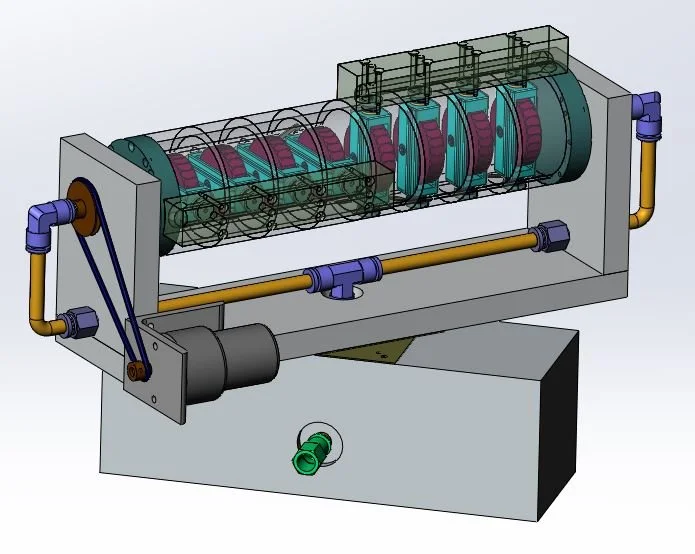
High-Speed Flywheel Balancing Simulator 2002–2003 | Quoin International (SBIR-funded Attitude Control System development) Designed and personally assembled a multi-rotor air-driven test rig capable of spinning flywheels at 10,000 RPM on 35 PSI shop air. Built to validate rotor balancing and dynamics for next-generation missile attitude control systems.
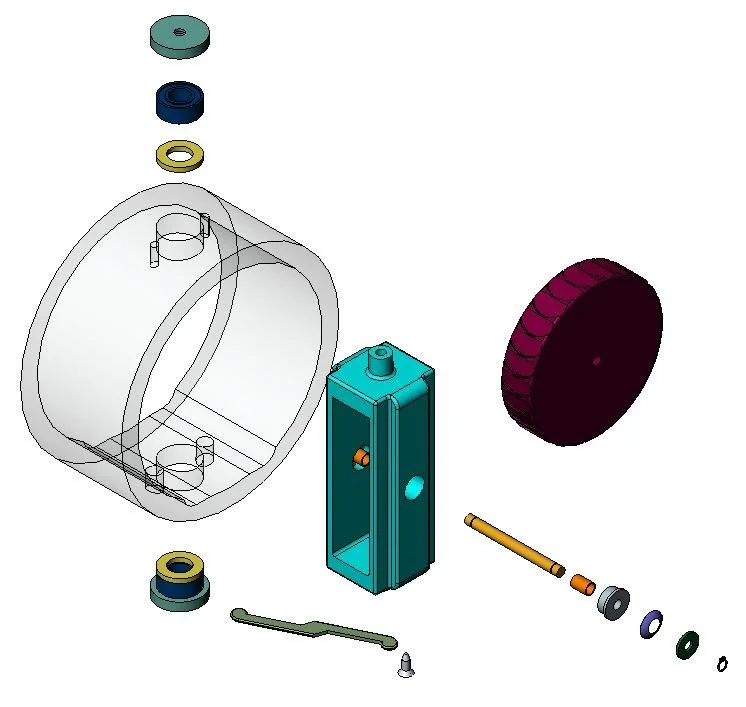
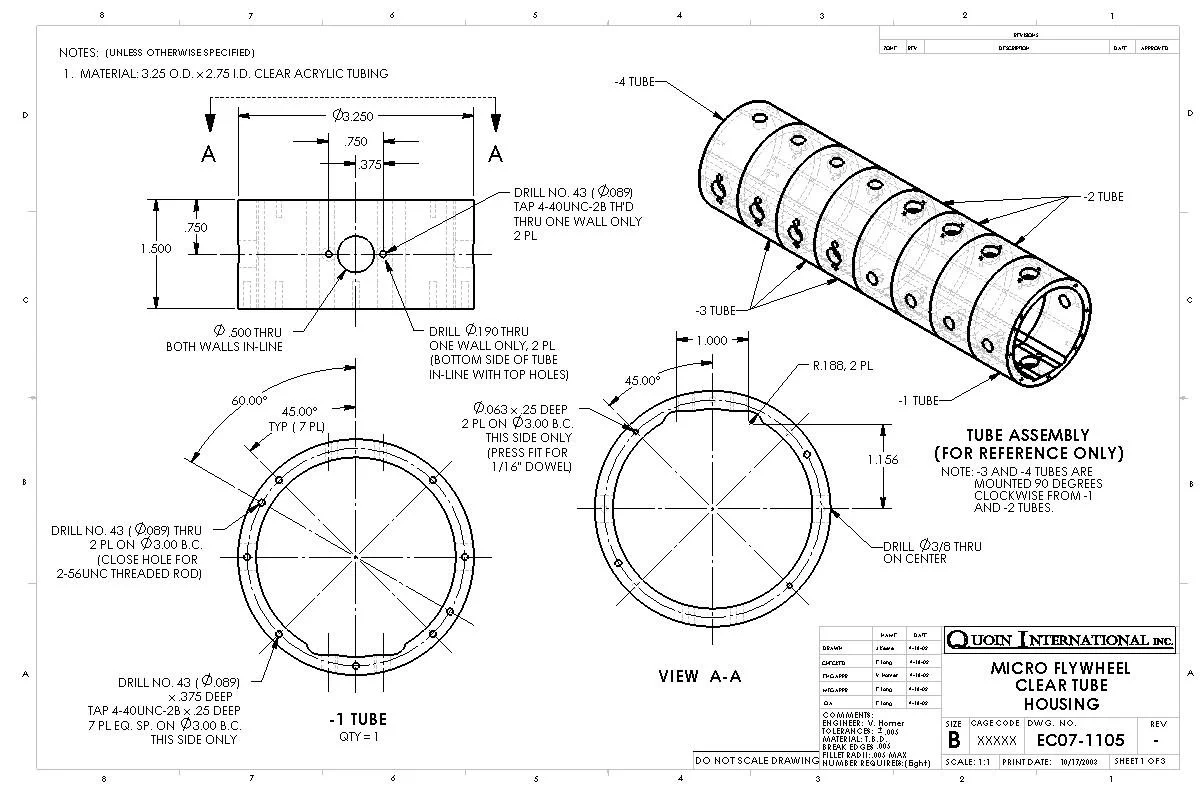
Detail drawing of the clear acrylic tubes. The flywheels were sub-assembled into each tube and sandwiched between two aluminum side caps. Secured with two 2-56 coarse thread rods.
Attitude Control System (ACS)
Quoin International, 2002
Designed the pitch-axis gimbal arms for a dual high-speed flywheel Attitude Control System for advanced missile and projectile applications.
Key Contributions:
Created the mechanical linkage that added precise pitch control to an existing yaw system
Worked with dual flywheels spinning at 50,000 rpm on a central ball-joint gimbal
Helped develop a compact, rugged mechanism for rapid attitude adjustments and target alignment
This project expanded the system from single-axis testing to full pitch + yaw control, improving stability and pointing accuracy.
Watch the video — pitch and yaw testing in action.
Integrated Flywheel Testing
(Early version of flywheel test stand)
free floating piston engine - prototype
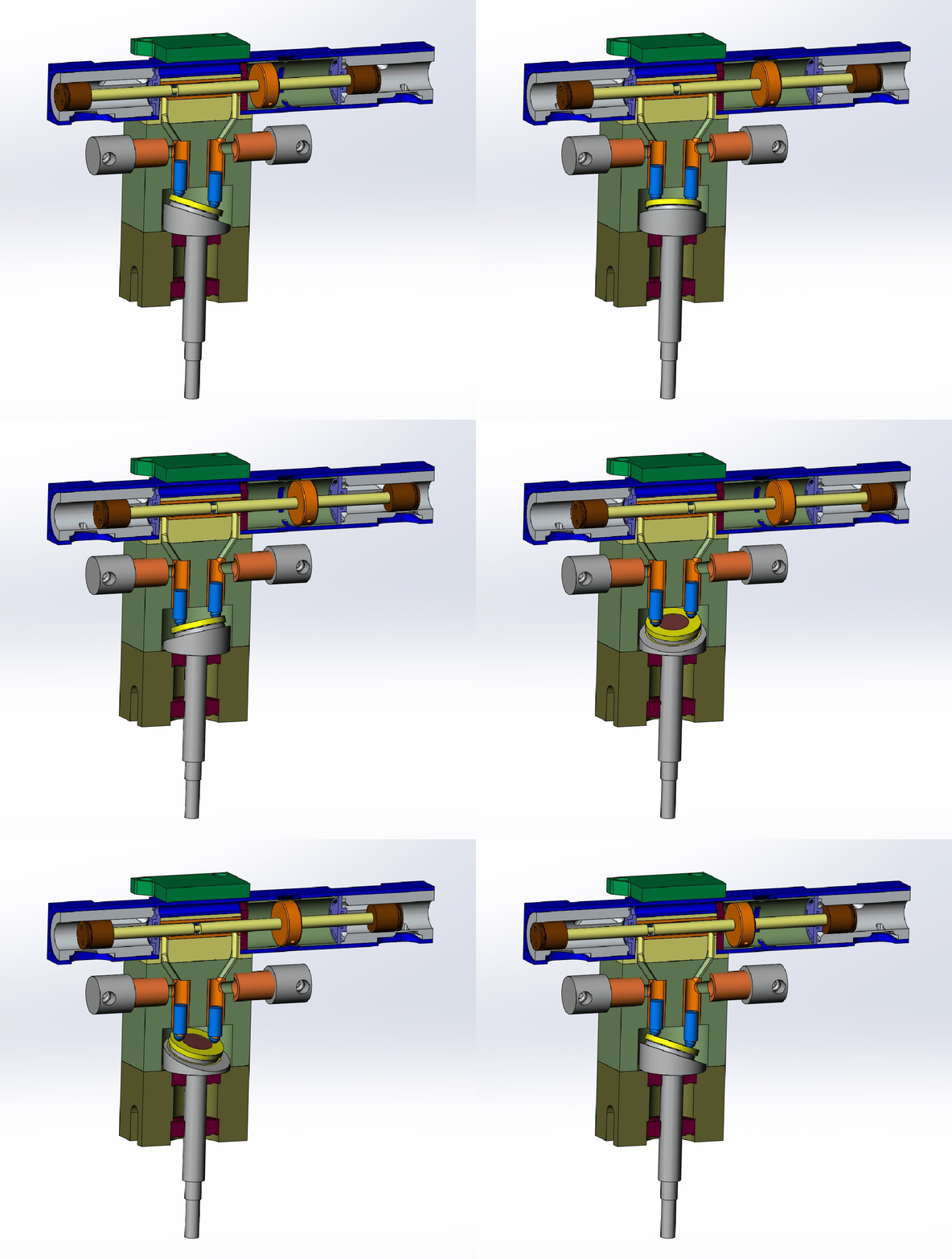
Led the 3D modeling and development of a compact free-floating piston engine prototype intended as a lightweight power source for military exoskeletons.
Key Contributions:
Created all 3D CAD models and detailed drawings based on engineering direction from Quoin’s owner and the design team.
Designed the "free-floating" piston mechanism shown in the cutaway view.
Coordinated rapid prototyping and personally arranged airbrushing of the display model for trade show demonstrations.
The goal of the project was to develop a high-efficiency portable power unit capable of supporting soldier-worn exoskeletons — allowing troops to carry heavy loads (up to 200 lbs) with significantly reduced fatigue.
This was an exciting early-stage prototype project that combined innovative mechanical design with real-world military application needs.
(Several Concepts were Designed and Tested)
man-lift winch assembly
Pneumatic Winch - Original Design
This was the first fully pneumatic version. It was successfully tested in downtown Ridgecrest, California, where a 150 lb tester climbed the side of a two-story building (with bed mattresses below for safety). Solid proof-of-concept that launched the whole project.
Electric Battery Powered Winch
Evolved from the pneumatic design using a Bosch drill motor for rechargeable battery power. This version is more portable and field-friendly, but initial concept a little less refined/polished than the original pneumatic build.
Battery-Powered Ascender (PowerQuick®)
Featured in official DARPA/SBIR Success Reports
Under a DARPA SBIR, I helped design and developed the PowerQuick® Powered Ascender while at Quoin International, in 2002. This rechargeable battery-operated device allows a single user to quickly ascend a rope for high-access work — ideal for search & rescue, firefighting, tower maintenance, and industrial applications. The pneumatic version was successfully field-tested, and the project later evolved into the commercial electric model.
I.R. CRUCIBLE assembly - HEAT SEAKING TARGET SOURCE
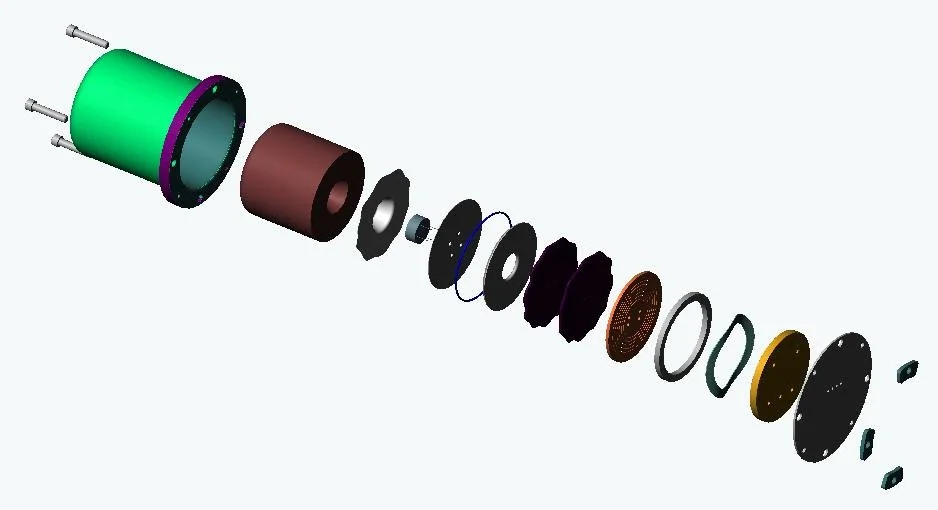
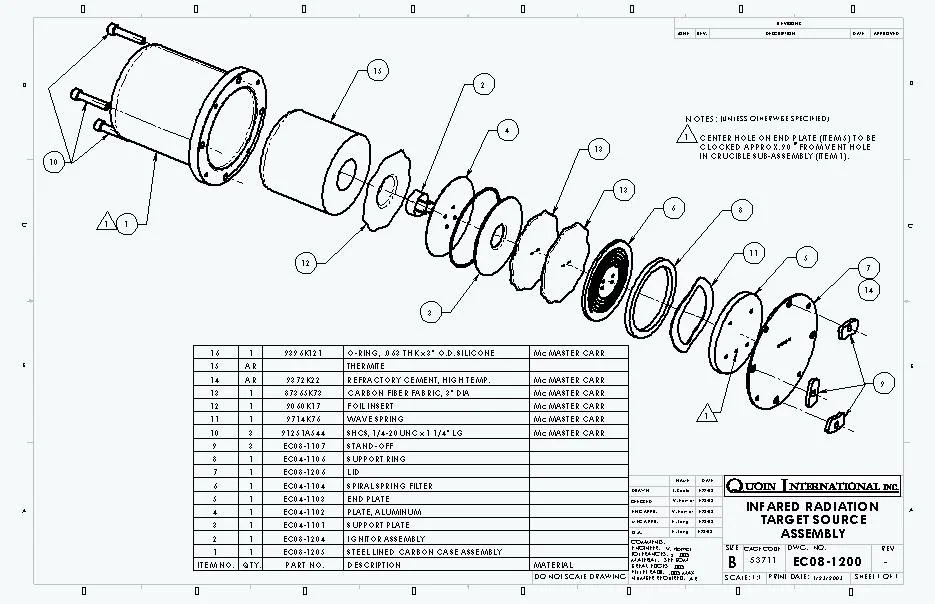
This is the Carbon Infrared (IR) Crucible project I modeled and was built in 2003 while working at Quoin International. It was developed as a high-temperature infrared heat source target for U.S. Military heat-seeking missiles. The system creates a realistic “red hot” burning target used to simulate threats during testing and training.
The thermite material was pressed at 10 tons of pressure into a custom aluminum cup that installs into the main housing assembly. To prevent distortion during pressing, I designed and machined a heavy-duty two-piece steel fixture as a project for my machine shop class at a local community college. The fixture was secured with (8) 3/8-24 UNF socket head cap screws. Once pressed, the fixture was disassembled to carefully remove the aluminum cup containing the dense thermite charge.
Each completed unit was then custom-packaged in a rugged, sealed metal container using a two-part chemical reaction that produced form-fitting protective foam. This ensured the sensitive components remained completely protected from moisture and contaminants during shipping and long-term storage.
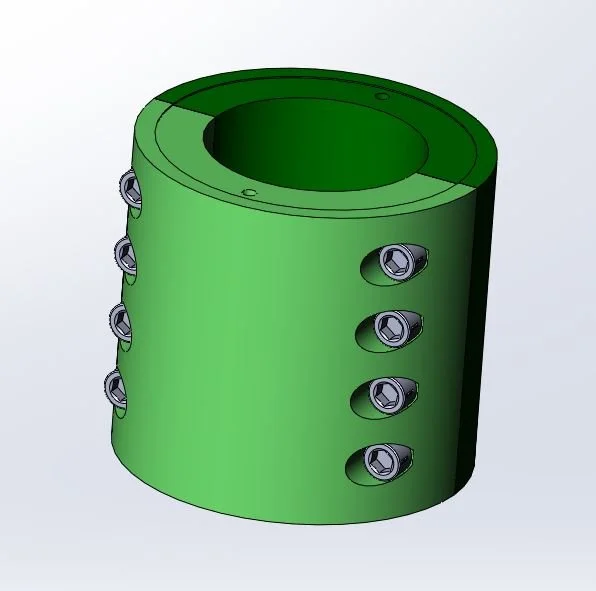
Steel Housing - designed to contain an aluminum cup and press 10 tons of thermite material without any distortion.